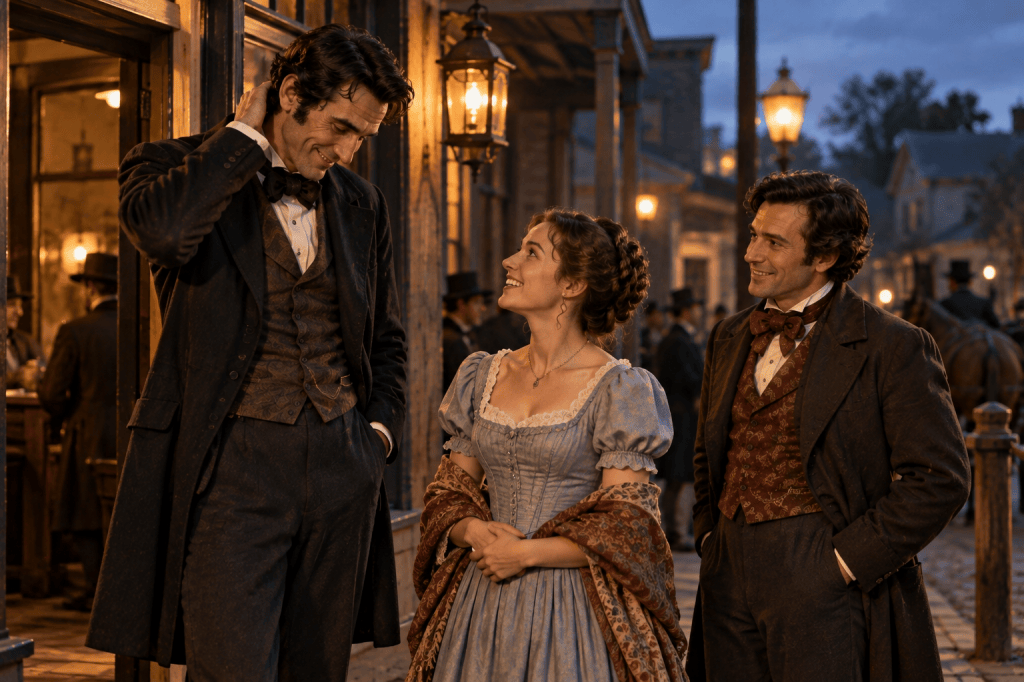
When we picture Abraham Lincoln, romance probably isn’t the first thing that comes to mind. We picture the president. The beard. The solemn photographs. The man who led the country through the Civil War.
But the Abraham Lincoln in Lincoln Seeks Justice for Elijah Lovejoy is only twenty-eight years old. He is unmarried. And he is very interested in women. That Lincoln is a lot more complicated than the awkward, shy young man we sometimes imagine.
Account from Lincoln’s younger years suggest a young man with a healthy sexual appetite. During the Black Hawk War, Lincoln and John T. Stuart visited brothels. Later recollections from his New Salem years also suggest that Lincoln may have had sexual relationships with married women. For an unmarried young man, a married woman could in one sense be a safer partner–she had as much reason as he did to keep the relationship secret.
Some of those recollections were recorded years afterward, particularly in interviews collected by his law partner and biographer William Herndon, so historians have had to weigh how much confidence to place in individual stories. But they certainly complicate the image of a sexually innocent young Lincoln.
By the time I meet him in my novel, Lincoln has moved to Springfield and become John T. Stuart’s law partner. Lincoln is not sexually naive. Courtship is another matter entirely.
Lincoln was extraordinarily tall and thin. He could be awkward in his movements and painfully conscious that he was not considered particularly handsome. He would make jokes about his appearance. His clothes didn’t always flatter him, either. Some of this was intentionally to win over a jury and say, “I’m like you, an ordinary man.”
Wanting a woman was very different from convincing one that she might want him. That gave me something fun to work with in the novel. Joshua Speed, Lincoln’s close friend, decides to help. He arranges a date. It does not go well. Lincoln gets talking. And talking. He becomes absorbed in the conversation and fails to notice that the young woman isn’t nearly as fascinated as he is. She is bored. And she isn’t interested in seeing him again.
Eventually, Lincoln realized what happened. He apologizes. And that goes considerably better. She agrees to go out with him again. That particular date is fiction. Lincoln’s sexual interest in women–and the accounts of his visits to brothels with Stuart–come from the historical record. The contradiction is interesting. Lincoln could be sexually experienced and still be insecure about his appearance.
He could be comfortable seeking sex and still be awkward at courtship, particularly when it came to selecting a wife. He could hold the attention of a courtroom, make a roomful of men laugh, and tell stories for hours–and still completely misjudge whether a woman was enjoying his company.
That’s one of the pleasures of writing Lincoln before he became the figure we recognize from history. In Lincoln Seeks Justice for Elijah Lovejoy, nobody around him knows he si going to become Abraham Lincoln. And neither does he. He is simply a twenty-eight-year-old lawyer trying to establish a career, make friends, earn enough money to live on–and occasionally figure out women. Sometimes he does better at one of those things than another.
Current Projects
- My Book: Continuing revisions of Lincoln Seeks Justice for Elijah Lovejoy, where Abraham Lincoln is still a young lawyer becoming he man history will remember.
- Edward Bryant: Continuing preparations for future publication and preservation of stories by my friend Edward Bryant.
Thanks for walking alongside me.

