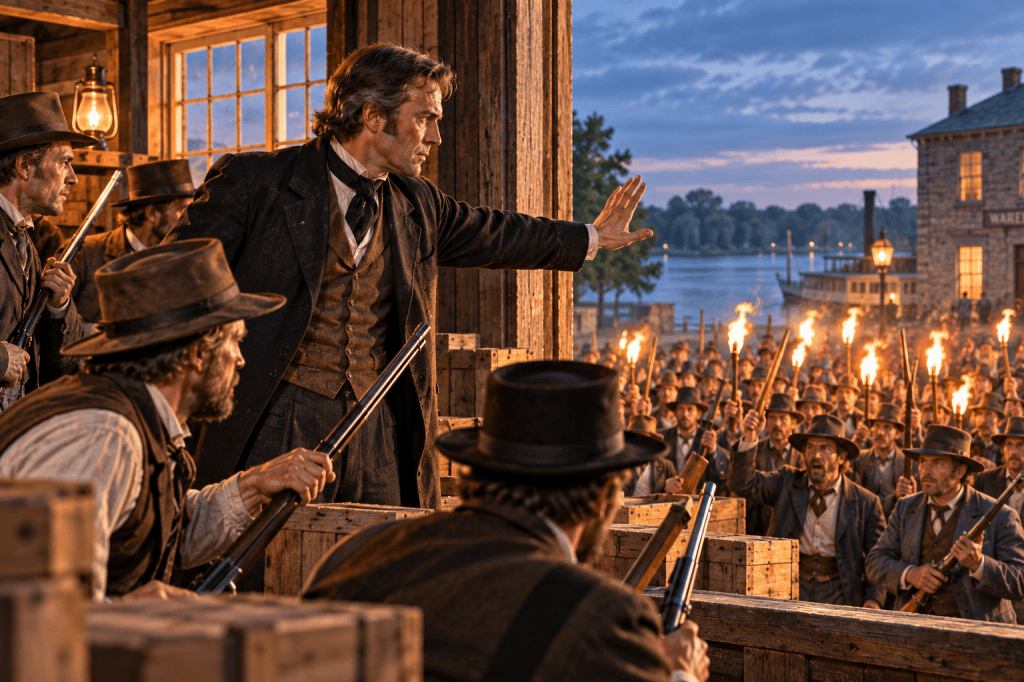
The men defending Elijah Lovejoy’s printing press were armed. So were the men threatening to destroy it. That left Enoch Long with a terrible responsibility. When, exactly, do you tell your men that are allowed to shoot?
Long was already deeply involved in the struggle surrounding Lovejoy in Alton. When armed men were needed to defend the home of Francis Hurlbutt, Long deputized them. Later, when men gathered to protect Lovejoy’s printing press, they elected Long their captain. That meant Long wasn’t simply another man carrying a gun. He was responsible for everyone else who was carrying one. He told his man they were not to fire unless they were fired upon. These were their neighbors and friends outside.
Not everyone agreed. Some of the defenders thought long was being too cautious. If they fired quickly, it might disperse the mob. It’s easy, nearly two hundred years later, to read about an armed confrontation and know how its history ended.
Long didn’t have that advantage. He had armed men under his command. Outside were other armed men. Tempers were high. Threats had already been made. Violence surrounding Lovejoy and his presses was nothing new. One frightened or angry man pulling a trigger could change everything. Long had to decide how long his men should wait.
They weren’t standing safely on the other side of history, knowing which choices would later look courageous and which would look foolish. They were making decisions in the moment. In Lincoln Seeks Justice for Elijah Lovejoy, that uncertainty matters.
The defenders of the press don’t all think alike. Some are committed abolitionists. Others are not. Some believe strongly in freedom of the press. Some are concerned about law and order. Some believe a man has the right to defend his property. Even men standing on the same side can disagree about how far they should go.
For Enoch Long, that question became very real. How do you defend the law without becoming another armed mob? How long do you wait before defending yourself? And what happens if waiting proves to be a mistake?
There is an irony in what happened afterward. When the confrontation was over, the authorities didn’t prosecute only the men who had come to attack the warehouse. They also charged men who had defended it. Long, warehouse owner Wintrhip Gilman and other defenders found themselves accused of riot.
The man who had cautioned his own men not to fire first now had to answer for participating in the violence he had tried to control. We often imagine courage as the willingness to act. Sometimes it is. But sometimes leadership means being the man surrounded by angry people with loaded guns who says: Not yet.
Current Projects
My Book: continuing revisions of Lincoln Seeks Justice for Elijah Lovejoy, where real historical people faced choices without knowing hos history would remember them.
Edward Bryant: continuing preparations for future publication and preservation of stories by my friend Edward Bryant.
Thanks for walking alongside me.

