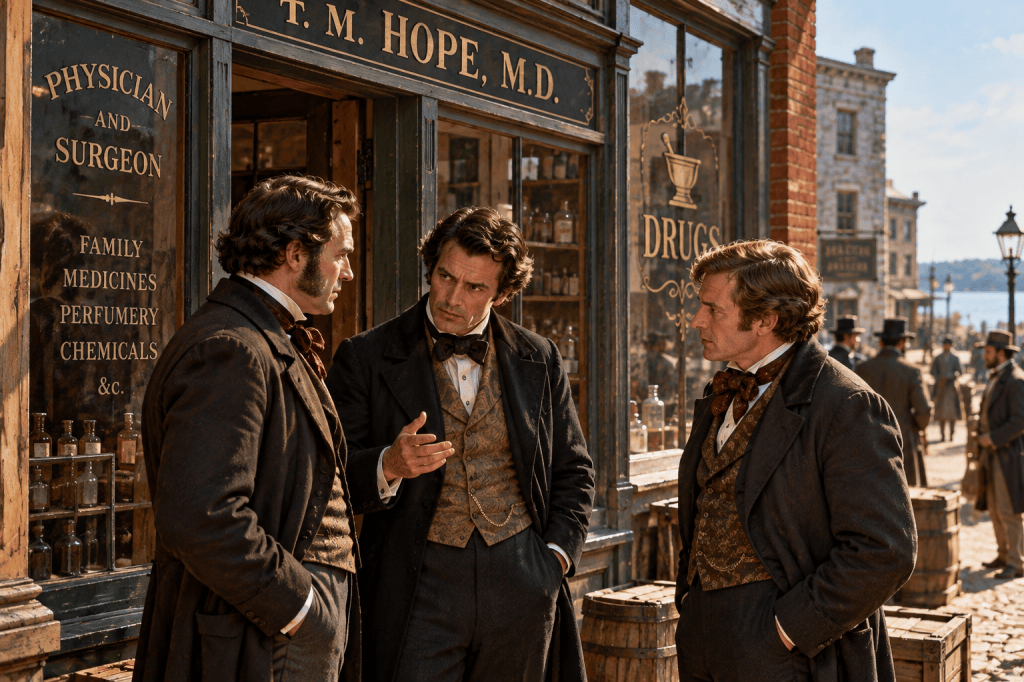
One of the things that surprises people most when I talk about my research for Lincoln Seeks Justice for Elijah Lovejoy is the role played by some of Alton’s doctors. We tend to think of a physician as someone who protects life. Three doctors in the Lovejoy controversy became involved in something very different.
Doctors Beall, Jennings, and Thomas Hoe were Southerners. All three opposed Lovejoy and his increasingly outspoken attacks on slavery. And their opposition went far beyond disagreement. All three made threats of violence. Beall and Jennings once intercepted an unarmed Lovejoy on the road intending to tar and feather him. They talked of putting him in a boat and sending him down the Mississippi wit orders not to return.
Lovejoy couldn’t stop them. Instead, he asked them to do one thing for him: deliver the medicine he was carrying home to his sick wife, Celia. Something about his courage changed the encounter. They let him go. But the threats didn’t stop.
There were even reports that Beall, Jennings, and Hope were connected with a secret group of twelve men who had threatened to kill Lovejoy. Who met with whom? What was said behind closed doors? How organized were those threats?
History doesn’t give me all of those answers. Historical fiction lets me imagine them. In Lincoln Seeks Justice for Elijah Lovejoy, I bring the three doctors together with Usher F. Linder and James Rock. Behind closed doors, the five men discuss something far more serious than stopping a newspaper. They plan to kill Elijah Lovejoy.
That scene is fiction. The threats surrounding Lovejoy were not. In my novel, Abraham Lincoln goes to Alton hoping to stop the escalating violence before it is too late. But Lincoln doesn’t know everything that is being planned–or how far some men are willing to go.
As the struggle over Lovejoy’s printing press becomes increasingly dangerous, Dr. Thomas Hope becomes directly involved. When a group of men confronts the defenders of the press inside a stone warehouse in Alton, Hope directs men to set fire to the roof.
And then there was Dr. Hart. Hart was different. He was not a Southerner, and he remained more neutral during the controversy. Later, he regretted his silence. He wished he had spoken up in Lovejoy’s defense.
Three doctors chose to threaten and act. Another chose silence. And he was left wishing he hadn’t.
When we look backward at history, it’s easy to imagine that people knew they were living through an important historical moment. They didn’t. They were simply making choices.
That’s something I explore in Lincoln Seeks Justice for Elijah Lovejoy. The people surrounding Lovejoy weren’t names neatly arranged on opposite sides of a historical argument. They were neighbors, businessmen, lawyers, politicians–and doctors.
Some acted. Some remained silent. And as the confrontation surrounding Elijah Lovejoy became increasingly dangerous, there was still time for every one of them to decide what kind of man he was going to be.
Current Projects
- My Book: Continuing revisions of Lincoln Seeks Justice for Elijah Lovejoy, where real historical people and their choices drive much of the story.
- Edward Bryant: Continuing preparations for future publication and preservation of stories by my friend Edward Bryant.
Thanks for walking alongside me.

