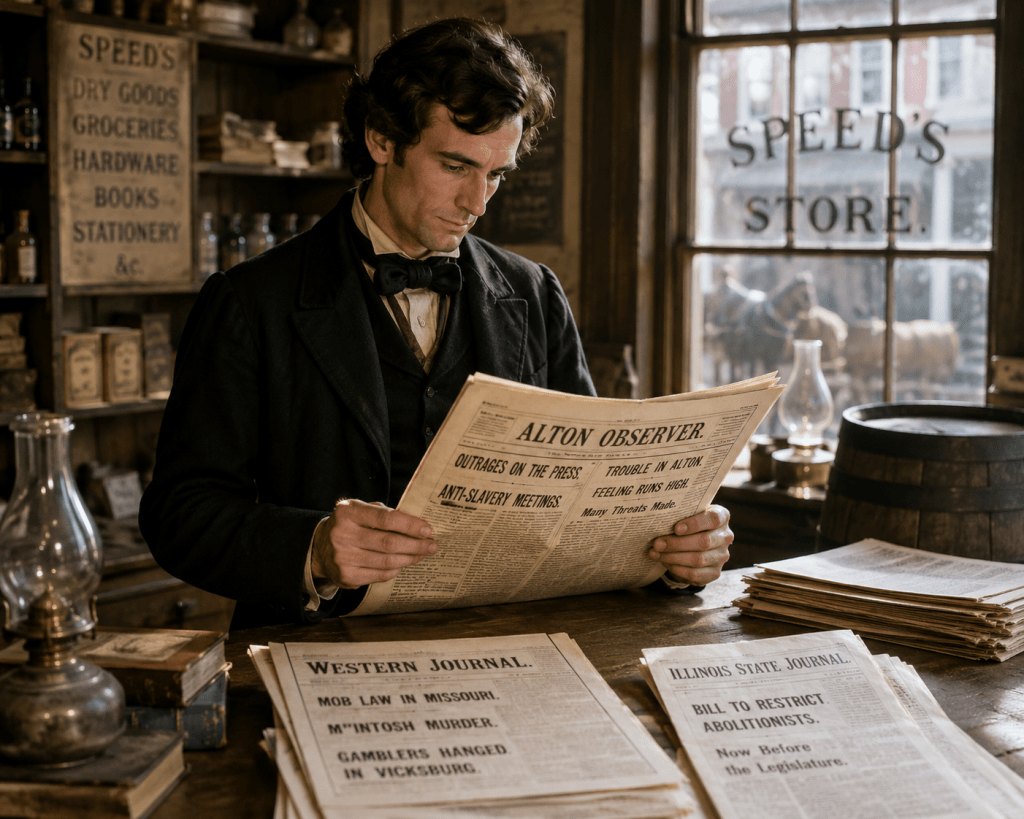
One of the questions I had to answer while writing my novel was obvious to me yet also a central premise of the work: Why would Abraham Lincoln care about Elijah Lovejoy? Why would he care about what happened in Alton and feel compelled to go there?
Lincoln and Lovejoy never met. When I began reading about the period, I realized that Lovejoy’s struggle was taking place against a much larger backdrop of violence and growing threats to the rule of law. By the 1830s, Americans had witnessed a troubling series of events. Reports of mob violence were appearing with disturbing frequency. Newspapers were attacked. Printing presses were destroyed. Anti-abolitionist violence was becoming increasingly common. Illinois politicians debated measures aimed at restricting abolitionist activity in the state. Political leaders considered how abolitionists should be treated and whether they should even be allowed to speak freely. Across the Mississippi River gamblers had been hanged by vigilantes. In St. Louis, Francis McIntosh had been burned alive by a mob.
These events were widely discussed. The controversary in Alton was especially visible because it involved a newspaper editor. Newspapers carried reports, editorials, accusations, and responses. Lovejoy himself wrote about many of the controversies surrounding his own situation and the repeated attacks on his presses. People throughout Illinois, Missouri, and beyond followed the growing conflict.
The issue was slavery alone. It was a combination of many issues plaguing this period in time that effected people of all types. At its heart was a question of whether disagreements would be settled through law or through violence. By the winter of 1837-1838, that question had become increasingly difficult to avoid. Reports of mob violence, attacks on property, and failures of justice were raising concerns throughout the region.
Only weeks after the Alton trials concluded, Lincoln would warn about exactly this danger in his Lyceum Address, arguing that mob violence threatened the foundations of American government. Reading about the events of the 1830s, it is not difficult to see why he might have felt that way.
As I worked on the novel, I had to ask myself how a young Lincoln might have reacted while watching these events unfold. How much did he know? What reports did he read? What conversations was he having with friends and fellow lawyers?
The story is not simply about one town or one controversy. It is about a moment when Americans were struggling to decide whether the rule of law would prevail over the passions of the crowd.
Those questions became the starting point for the novel. They drew me into the book and remain one of the reasons I continue to find this period so fascinating.
Current projects:
My book: continuing revisions and incorporating feedback from my writers group
Edward Bryant: continuing to review stories for future publication
Historical fiction often begins with a simple question. Sometimes that question is what if. Sometimes it is why. A novel often begins not with an answer, but with a question that refuses to go away.
For me, one of the most important questions was: Why would Abraham Lincoln decide that what was happening in Alton mattered?
Thanks for reading and walking alongside me.

