You might think the hardest part of writing a historical mystery featuring Abraham Lincoln would be getting Licnoln himself right. For a while, it was. When I began writing Lincoln Seeks Justice for Elijah Lovejoy, I struggled to find Lincoln’s voice. I wanted him to sound like a real young man in 1837, not the solemn figure we recognize from his presidential photographs. He was witty, intelligent, and well-written. But something interesting happened. The more I wrote him the easier his voice became. Eventually writing Lincoln’s dialogue and inner monologue felt natural.
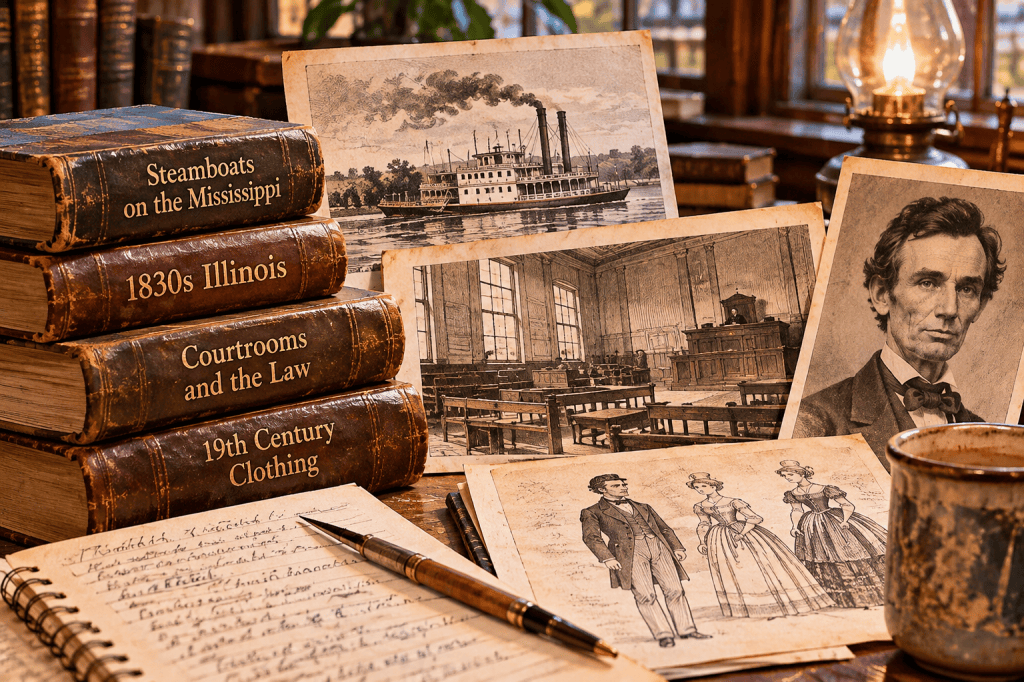
The research, however, never got easier. Historical fiction requires an extraordinary amount of attention to detail. For example, Elijah Lovejoy’s printing press arrives in Alton by boat. That may sound simple enough. But what boat? What did it look like? How did it operate? What would the river front have looked like when it arrived? Suddenly a scene that might occupy only a few paragraphs requires hours of research.
Then there are clothes. What would Lincoln wear to court? What type of coat did he wear? How would a prosperous businessman dress? What about a laborer or a newspaper editor?
Clothing can tell readers a great deal about a character without requiring a paragraph of explanation. But only if I get it right. And then there are the courtroom scenes. Those were particularly difficult.
I researched the actual historical trials, and it was tempting to follow the proceedings too closely. Unfortunately, what makes a trial valuable to a historian doesn’t necessarily make it entertaining to a reader. Real trials can be repetitive. Testimony can wander. Legal arguments can become tedious. A novelist has to make choices.
I wanted the courtroom scenes to preserve the historical substance while allowing readers to experience the tension between the people involved. The witnesses have their own perspectives. The lawyers have their strategies. And the consequence of the violence reach far beyond the courtroom.
My responsibility isn’t to reproduce a trial transcript. It’s to tell a compelling story grounded in history. That’s the challenge I encounter throughout Lincoln Seeks Justice for Elijah Lovejoy. Sometimes I spend hours researching a detail that appears in only a sentence or two. Sometimes I discover something fascinating that doesn’t belon in the novel at all. And sometimes the research gives me an unexpected diea that makes a scene better.
The reader may never know how much work went into identifying a steamboat, describing a courtroom, or choosing a character’s clothing. That’s perfectly fine with me. If I’ve done my job well, readers won’t be thinking about the research. They’ll be too busy enjoying the story.
Current Projects
My Book: Continuing revisions of Lincoln Seeks Justice for Elijah Lovejoy, where historical research provides the foundation for a fictional mystery featuring a young Abraham Lincoln.
Edward Bryant: Continuing preparations for future publication and preservation of stories by my friend Edward Bryant.
Thanks for walking alongside me.

