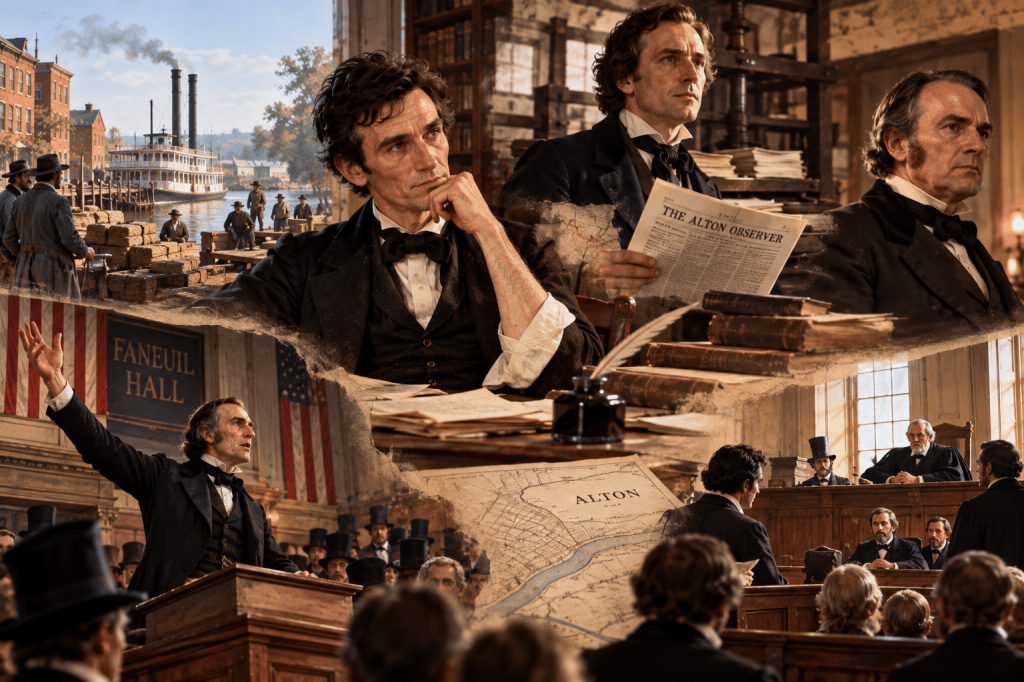
When two people witness the same event, do they see the same thing? Not necessarily. One person sees a threat. Another sees someone standing up for his beliefs. A third is worried about his business, his family, or simply getting home safely. That’s one of the reasons I chose to tell Lincoln Seeks Justice for Elijah Lovejoy in third person, moving between different characters’ points of view.
In one scene, readers may see events through Abraham Lincoln’s eyes. In another, they’re with Elijah Lovejoy, Winthrop Gilman, over even a minor character who appears only briefly. Each person has a different understanding of what’s happening and who is at fault.
Lincoln approaches problems as a young lawyer. Lovejoy is a minister and newspaper editor who refuses to abandon his principles. Gilman is a businessman whose property and livelihood become entangled in the controversy. And the people opposing Lovejoy have their own beliefs, ambitions, fears, and motives.
I wanted readers to experience those differences rather than simply have someone explain them. That also allows me to show things happening in different places at the same time. While one character is making a decision, another may be preparing to do something that will change everything. The read can see connections that the individual characters cannot.
But the story doesn’t remain in Alton. I also take readers beyond Illinois to see how the controversy is affecting the nation. One of those scenes takes place at Boston’s famous Faneuil Hall, where Windell Phillips delivers a passionate speech that helps establish his reputation as one of America’s leading abolitionist orators.
By moving between the people directly involved in Alton and those responding elsewhere, I can show how a local confrontation becomes part of a much larger national struggle.
And then we get to the courtroom.
This is where that approach becomes especially interesting. People who experienced the same violence return to it through their testimony. But they don’t necessarily remember t the same way, interpret it the same way, or understand its consequences in the same way. For some, the confrontation has become a question of law. For others, it has changed their lives.
The courtroom gives me an opportunity to explore not only what happened, but what those events meant to the people involved. And because this is a mystery, the differences between what people saw, what they remember, and what they’re willing to say can matter a great deal.
I could have told the entire story through Lincoln’s eyes. But then readers would know only what Lincoln knows. I wanted them to stand beside Lovejoy, worry with Gilman, listen tot eh men planning violence, and experience the uncertainty of people caught in the middle. Mostly, I wanted to understand why they did what they did.
I also wanted Alton to feel like a real community, filled with people whose lives intersect in ways they don’t always understand. That’s why I chose this way of telling the story. There isn’t just one story unfolding in Alton. There are dozens. And together, they become the mystery Lincoln must unravel.
Current Projects
My Book: Continuing revisions of Lincoln Seeks Justice for Elijah Lovejoy, using the perspectives of different historical and fictional characters to bring the events in Alton to life.
Edward Bryant: Continuing preparations for future publication and preservation of stories by my friend Edward Bryant.
Thanks for walking alongside me.

