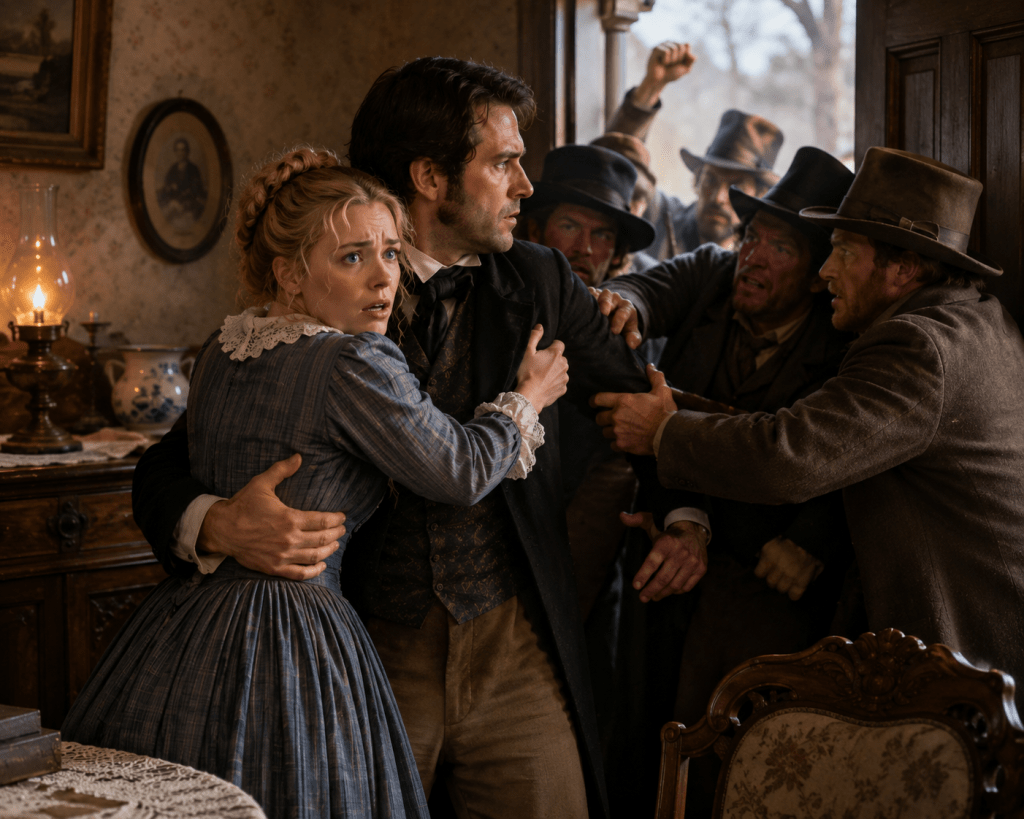
Imagine several angry men trying to drag your husband out of the house and into the street. You don’t know what they intend to do once they get him outside, but they have threatened before to kill him. You only know that you cannot let them take him. So you wrap yourself around him and hold on. This is what Celia Lovejoy did.
Long before the most dangerous days of the controversy surrounding Elijah Lovejoy in Alton, his wife had already learned what it meant to love a man whose convictions made him enemies.
Celia was young and attractive, with blonde hair and blue eyes. Elijah wrote about her to his family, and his letters reveal how deeply he loved and valued her. She was not simply standing in the background of his public life. She gave him emotional support in his work as a minister and newspaper editor became increasingly controversial. She also had every reason to be frightened.
During one visit with Celia’s parents in St. Charles, Missouri, a mob came after Elijah. The men tried to pull him from the house and take him into the street. Celia clung to him. She could hear the anger voices. She could feel the men pulling at the husband she loved. She knew what mobs were capable of doing, and there was no guarantee that they would hesitate because a young woman stood in their way.
But she would not let go. She begged and pleaded for them to leave. Eventually, the men gave up. They would not injure a woman. Only after Elijah was safe did Celia collapse, sobbing. It is a pivotal moment in both their lives. Celia was afraid. She acted anyway. And this was not the only time Elijah’s public battles entered her private life.
When a mob attacked his newspaper operation in St. Louis, Celia’s belongings–including possessions from her wedding–were thrown into the Mississippi River. She did not cry for their loss. She told her husband as long as they had not hurt him, she had all she needed. Those weren’t political pamphlets. They weren’t editorials. They were the personal belongings of a young woman whose husband had angered people with the words he printed.
The fight over slavery and freedom of the press had quite literally entered her home. Eventually Elijah and Celia moved across the Mississippi to Alton, Illinois, hoping for a new beginning. But the controversy did not disappear.
By 1837, Celia had a toddler son and was pregnant again. She was frequently ill and nervous, sometimes so sick that she couldn’t even get out of bed. And still, she supported Elijah and never complained. That is one of the things that makes her so interesting.
Celia had grown up in a slaveholding Missouri family. Elijah’s increasingly outspoken opposition to slavey could hardly have been something she accepted casually. Yet the historical record shows a woman who continued to stand beside her husband even as his convictions brought danger ever closer to their family.
When we read history, it’s easy to concentrate on the people making speeches, writing editorials, arguing politics, and appearing in newspaper headlines. But what about the people who loved them? What was it like to kiss your husband goodbye when you knew people had threatened him?
What did Celia think when another press was attacked/ What did she say to Elijah when they were alone? From the record, I don’t believe she ever asked him to stop. She knew why he was doing it. Those are some of the questions historical fiction allows me to explore in Lincoln Seeks Justice for Elijah Lovejoy.
The public record preserves many of Elijah’s words. It preserved far fewer of Celia’s. But it perseveres enough for me to know that she was much more than “Elijah Lovejoy’s wife.” She was a young mother. A pregnant woman struggling with illness. A daughter of a slaveholding family who resented that her husband had put them all in danger. A woman who watched mobs destroy pieces of her own life.
And when men came to take the man she loved, Celia Lovejoy put herself between him the mob and refused to let go.
Current Projects
- My Book: Continuing revisions of Lincoln Seeks Justice for Elijah Lovejoy, my historical mystery featuring a young Abraham Lincoln and the real people whose lives became entangled in the controversaries of 1830s Illinois.
- Edward Bryant: Continuing preparations for future publication of stories by my friend Edward Bryant.
Thanks for walking alongside me.
 The View From The Imaginarium