Today, we are surrounded by information. Newspapers, television, websites, podcasts, and social media compete constantly for our attention. If we disagree with one voice, there are hundreds of others waiting for us.
The world Abrham Lincoln knew was very different. In the 1830s, a newspaper editor could wield enormous influence in his community. His newspaper didn’t simply report the news. It argued politics, promoted candidates, attacked opponents, shaped public opinion, and sometimes challenged the beliefs of the people who read it. There were few alternatives for citizens to turn to.
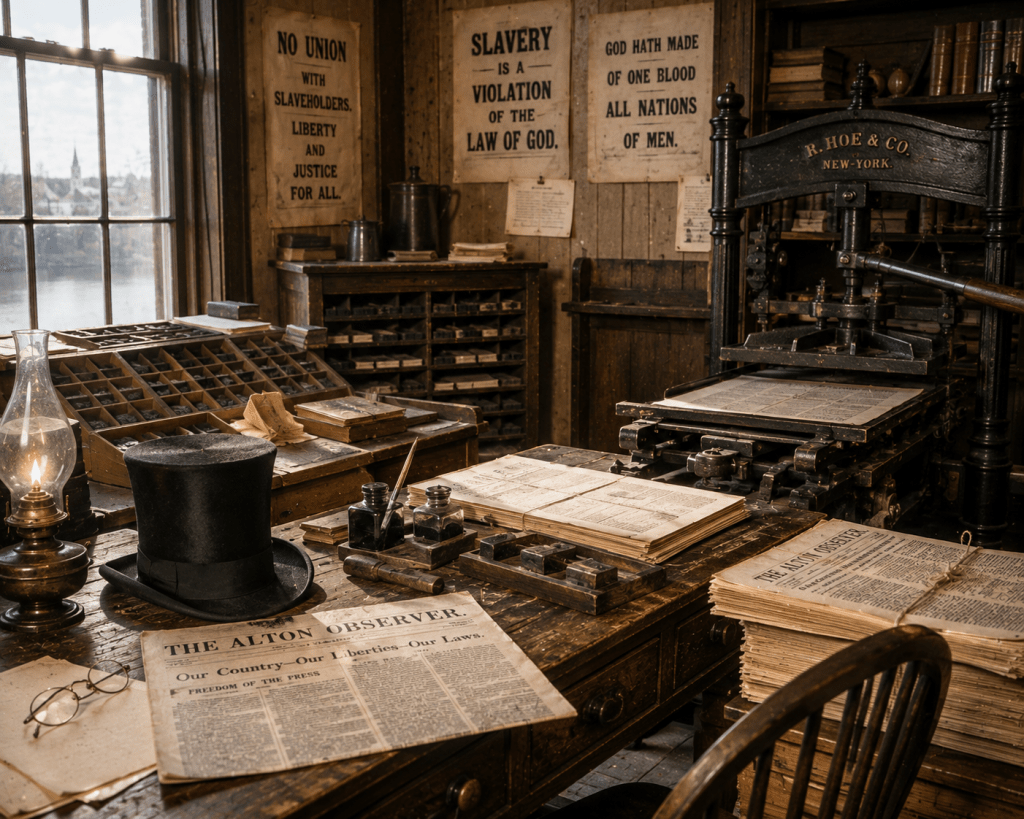
That helps explain why Elijah Lovejoy’s printing press became such a source of controversy. Lovejoy was a Presbyterian minister and newspaper editor who used his press to speak out against slavery. He believed slavery was morally wrong, and he became increasingly outspoken about abolition. Not everyone wanted to hear it.
Alton, Illinois, sat directly across the Mississippi River from the slave state of Missouri. The city depended upon commerce along the river, and its economic and social connections crossed state lines. Arguments about slavery weren’t taking place somewhere far away. They were happening in people’s churches, businesses, homes, and streets.
And Lovejoy kept printing. That was the power of the press. Destroy an individual copy of a newspaper and another could be printed. Argue with Lovejoy and he could answer in his next editorial. Threaten him and, as long as his press continued to operate, his words could continue to travel far beyond the room in which he wrote them.
His opponents weren’t simply confronting one man. They were confronting his ability to be heard. That is one of the things that fascinated me when I began researching Lincoln Seeks Justice for Elijah Lovejoy. The controversy wasn’t simply about whether people agreed with Lovejoy. It raised a much larger question.
What happens when a community decides that an idea is so dangerous that the person expressing it should be silenced?
Freedom of the press sounds like an abstract principle until someone prints something you desperately wish they wouldn.t Then the principle becomes much harder. Those arguments were unfolding in the Illinois of young Abrahm Lincoln. Questions about slavery, abolition, freedom of speech, freedom of the press, law, and the rights of individuals were coming increasingly difficult for Americans to avoid.
They are also part of the world I wanted readers to enter in Lincoln Seeks Justice for Elijah Lovejoy. I don’t want readers simply to know that Lovejoy owned a printing press. I want them to understand why people cared so much about what come off it. And why some of them were so determined to make it stop.
Current Projects
- My book: Continuing revisions of my historical mystery featuring a young Abraham Lincoln and the real people and controversies of 1830s Illinois.
- Edward Bryant: Continuing preparations for future publication of stories by my friend Edward Bryant.
Thanks for walking alongside me.

