To those of you who have been exploring Lincoln’s world with me, welcome back.
As I wrote Lincoln Seeks Justice for Elijah Lovejoy, I thought about a question that would have seemed perfectly natural in Illinois during the autumn of 1837:
Why was everyone talking about Alton?
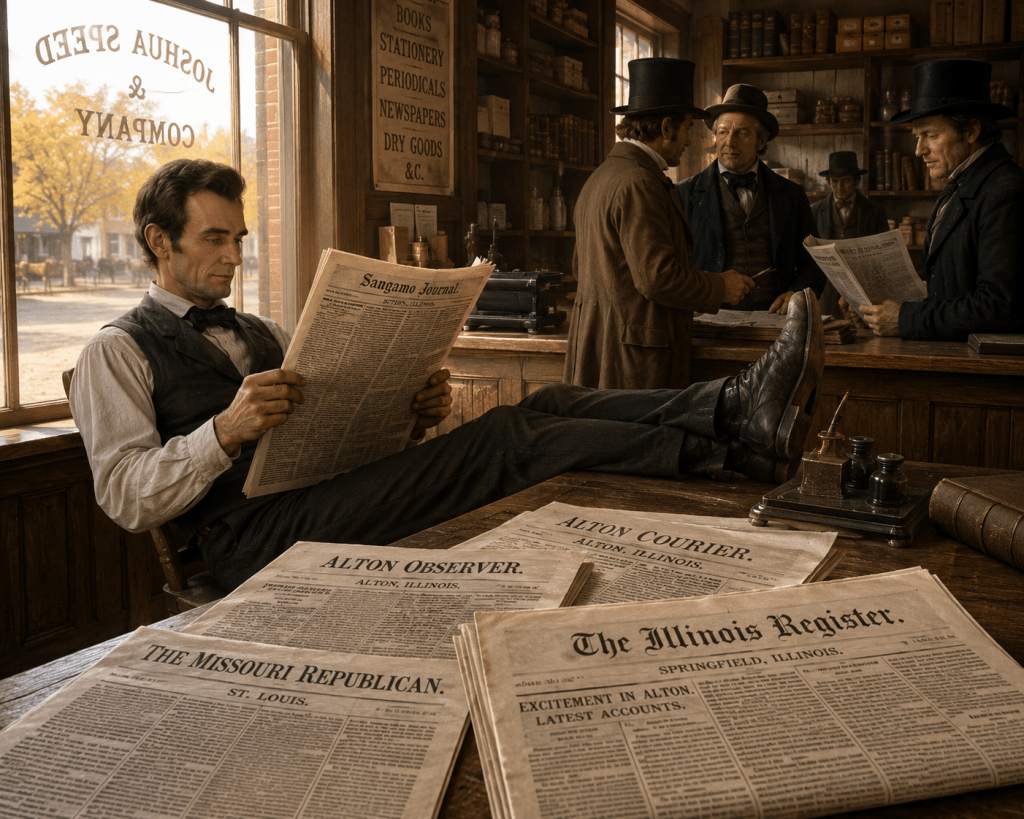
Today, Alton is a quiet river town on the Mississippi River. But in the late 1830s, it became the center of a national conversation. Newspapers across the country were carrying reports from Alton. Politicians debated what was happening there. Ministers preached sermons about it. Ordinary citizens discussed it in stores, taverns, and public squares.
A young lawyer and state legislator names Abraham Lincoln could hardly have avoided those conversations. Lincoln served in the Illinois legislature, where some of the men involved in the controversy were fellow legislators. Among them was Usher F. Linder, Illinois’s Attorney General, one of the state’s most prominent lawyers and someone Lincoln knew well from both politics and the Eighth Judicial Circuit. The people making news in Alton were not strangers appearing in newspaper columns. They were part of Lincoln’s plitical and professional world.
What made Alton so Important?
That question first drew me to this story. I soon discovered that the town itself was only part of the answer. Alton had become the focal point for a national debate. What was unfolding there mattered far beyond one community along the Mississippi River.
As I researched the period, I realized that Alton was not simply the scene of a local controversy. It was the place where issues that had been building across the country were coming to a head. Questions about abolition, freedom of the press, free speech, and the rule of law were no longer abstract political debates. In Alton, those issues collided in ways that drew the attention of politicians, ministers, newspaper editors, and ordinary citizens across the nation–including men like Abrham Lincoln.
One of the pleasures of writing historical fiction is discovering how connected history really is and bringing it to life in the modern world. The people in my novel are not isolated characters. They are lawyers, editors, ministers, politicians, merchants, and citizens whose lives intersect in ways that history often overlooks. I had their names and a few facts about them and had to imagine what they were really like under the circumstances unfolding in Alton.
The more I research Lincoln’s early years, the more I appreciate that his world was much smaller than we sometimes imagine. News traveled through newspapers and letters, but it also traveled through conversations among colleagues, friends, political rivals, and neighbors. That realization effected how I wrote these characters.
Current projects:
- My book: continuing revisions of Lincoln Seeks Justice for Elijah Lovejoy.
- Edward Bryant: Continuing to prepare his stories for future publication
Sometimes the most interesting question isn’t what happened. It’s why everyone was paying attention before history had its answer.
Thanks for continuing to explore Lincoln’s world with me.

