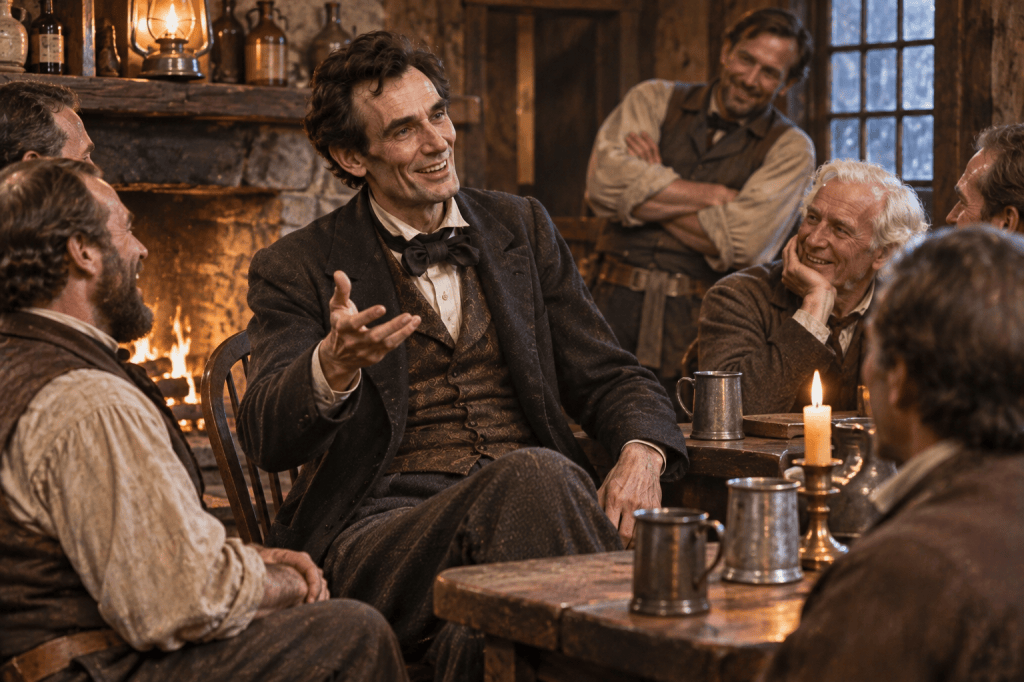
Abraham Linoln was famous for telling stories. Long before he became president, he had a reputation for entertaining people with jokes, anecdotes, and humorous observations. But his ability to put people at ease was also one of his greatest strengths as a lawyer.
In my historical mystery, Lincoln Seeks Justice for Elijah Lovejoy, Lincoln travels to Alton, Illinois, in 1837, where the controversy surrounding an abolitionist newspaper editor has divided the community. He needs to understand what’s happening. And that means talking to people. Some are willing to share their opinions. Others are more guarded. Nearly everyone seems to have something to say about Elijah Lovejoy, whether they support him or not.
How does a young lawyer persuade someone to open up? Lincoln wasn’t a polished, imposing figure. He was tall, awkward, and rather unconventional in appearance. But he possessed something that could be more useful than an impressive appearance. He knew how to talk to ordinary people. His humor was part of that ability. A good story could break the tension in a conversation. A joke could make a stranger comfortable. And a seemingly casual question might reveal something important.
Of course, that doesn’t mean everyone trusted Lincoln or that he could charm his way into every conversation. In Alton, the disagreements over Lovejoy involved religion, politics, slavery, freedom of the press, and deeply held personal convictions. These were not subjects people discussed lightly.
One of the challenges I faced in writing Lincoln was deciding how he would approach different people. He couldn’t speak to a frightened witness the same way he spoke to an angry businessman. A conversation with an old friend would be different from one with a complete stranger. And sometimes listening would accomplish more than talking.
The more I understood Lincoln’s personality, the easier these scenes became to write. He didn’t have to dominate every conversation. He could be curious, amusing, sympathetic, persistent, or occasionally irritating. In other words, he could be human. That’s the Lincoln I wanted readers to meet in Lincoln Seeks Justice for Elijah Lovejoy. Not the president who face appears on the five-dollar bill, but a young man learning how to use his considerable abilities in a complicated and dangerous world.
And perhaps one of his most useful abilities was knowing when to tell a stroy–and when to listen.
Current Projects
- My Book: Continuing revisions of Lincoln Seeks Justice for Elijah Lovejoy, the first novel in the Lincoln Mysteries series.
- Edward Bryant: Continuing preparations for future publication and preservation of stories by my friend Edward Bryant.
Thanks for walking alongside me.

