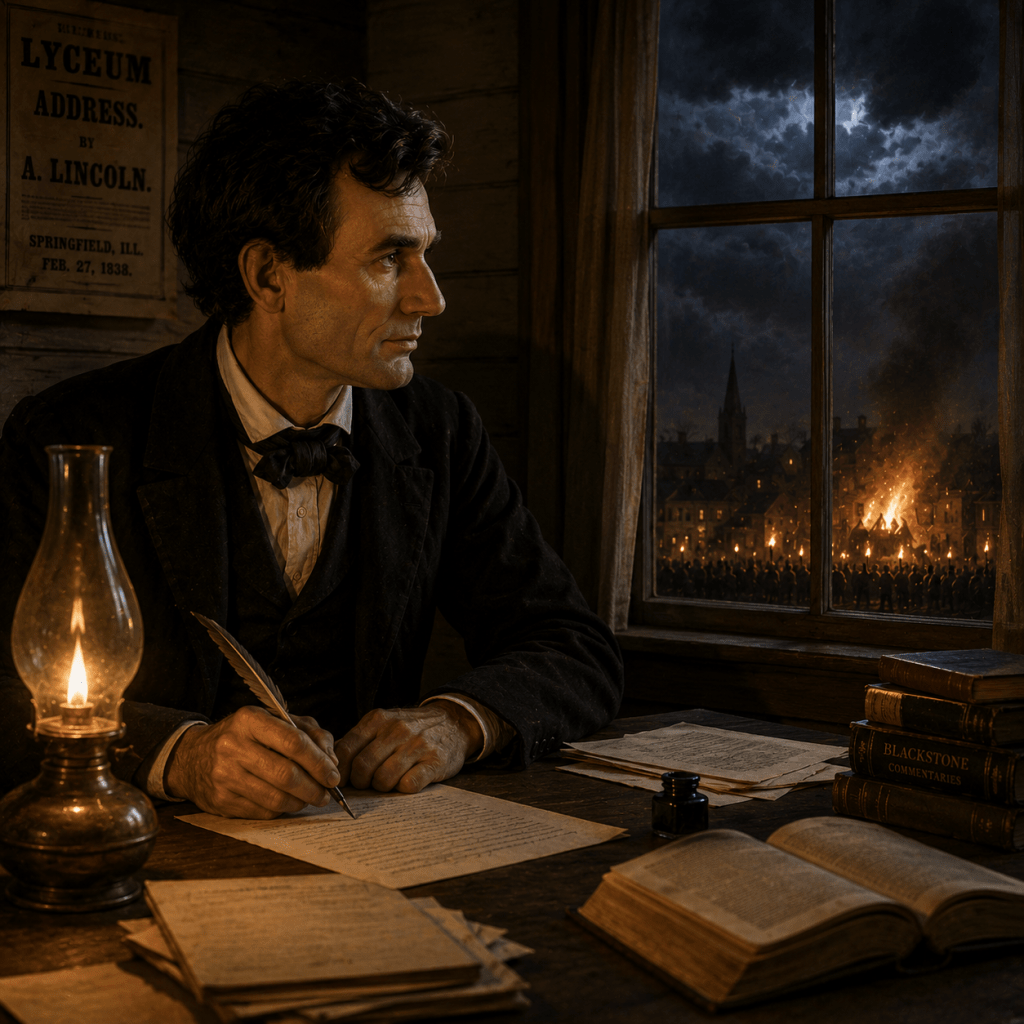
As I follow Abraham Lincoln’s life and work on my novel, there is one idea that keeps appearing again and again in his early thinking: the fear that civilization itself could begin to unravel. Lincoln lived during a period of growing instability in the United States. Mob violence, political anger, and deepening sectional divisions were becoming increasingly common. The murders of Francis McIntosh and Elijah Lovejoy were signs of something larger and more dangerous.
What troubled Lincoln was not only the violence itself. He feared what would happen if Americans gradually lost faith in law, institutions, and restraint. In the Lyceum Address, he warned that a nation could not survive indefinitely if passion and mob action replaced respect for legal order. That concern feels remarkably modern.
Lincoln was already thinking in these terms while still a relatively young man in Illinois. He was not yet confronting civil war directly, but he already sensed how fragile civilization could become when anger and division overwhelmed the structures holding society together. That understanding became one of the foundations of his later leadership.
In writing my novel, this matters because the tensions surround Lovejoy’s death are not simply historical background. They are part of the atmosphere that shaped Lincoln’s political and moral thinking long before he entered the White House. What makes this more compelling is the way Lincoln himself eventually died.
The same breakdown in law and restraint that he feared in the Lyceum speech ultimately claimed his own life. John Wilkes Booth chose violence over law and placed himself above legal authority, just as the mobs that killed McIntosh and Lovejoy had done years earlier. In that sense, Lincoln died because of the very danger he had warned the nation about decades before. I see the Lyceum Address not as an isolated early address, but as a warning that echoed throughout Lincoln’s entire life.
Current projects:
- My book: revising Chapter 10 (when I’m not pulling weeds in the garden or working at the hospital)
- Edward Bryant: continuing to read through stories for future publication
History sometimes reveals its deepest truths only when we look at how events connect across time.
Thanks for reading and walking alongside me.

