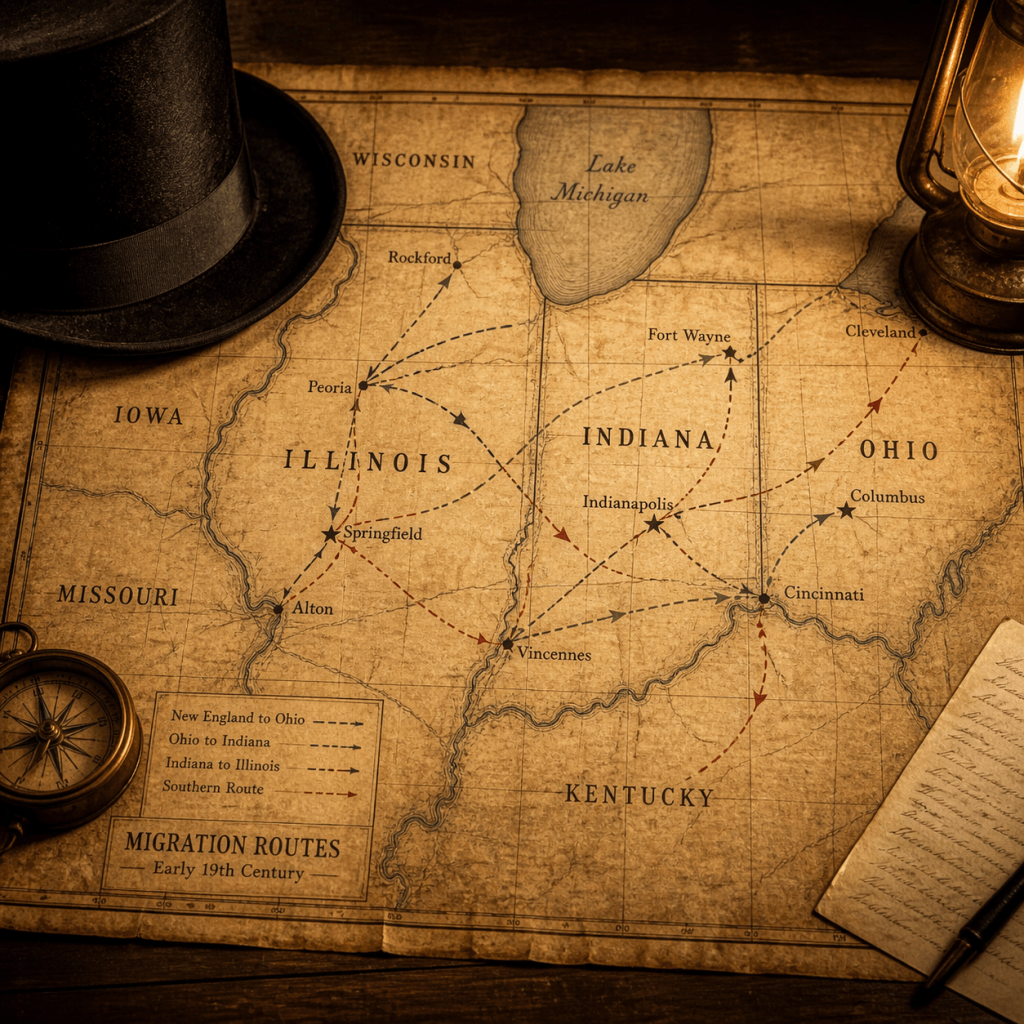
This week I spent time researching through a section of family history, tracing connections between the Pelton, Warren and Mayhew families. What stands out is not a single event but the pattern. These families are connected through marriage, shared Quaker roots, and a migration path from New England into Ohio, Indiana, and the broader Midwest. As the lines come together, it becomes clear that history does not move through isolated individuals. It moves through networks.
Lincoln himself was part of that same regional movement. His family came into Indiana and later Illinois, via the via the South, Viriginia and Kentucky, still becoming part of the developing Midwest. He wasn’t separate from these patterns. He was shaped by them. His morals and beliefs.
We often focus on Lincoln as a single figure, but he lived within a web of communities, beliefs, and relationships that defined the time. The people around him were not isolated, either. They were part of overlapping circles–families, religious groups, and local networks that carried ideals forward.
Looking at these family connections, I am reminded that history is not only made by the people whose names we remember. It is sustained by many others whose lives intersected in quieter ways. In writing my novel, I bring some of those people forward to interact with Lincoln. It is not only the major events that shape the story but the people and communities that surround them. They are the ones who carry ideas, influence actions, and create the conditions in which history unfolds.
Current projects:
- My book: continuing to revise Chapter Ten
- Edward Bryant: continuing to review stories for future publication.
The more I study these connections, the more I see history not as a series of isolated moments, but as something that moves through people–often in ways we only begin to udnerstand much later.
Thanks for reading and walking alongside me.

