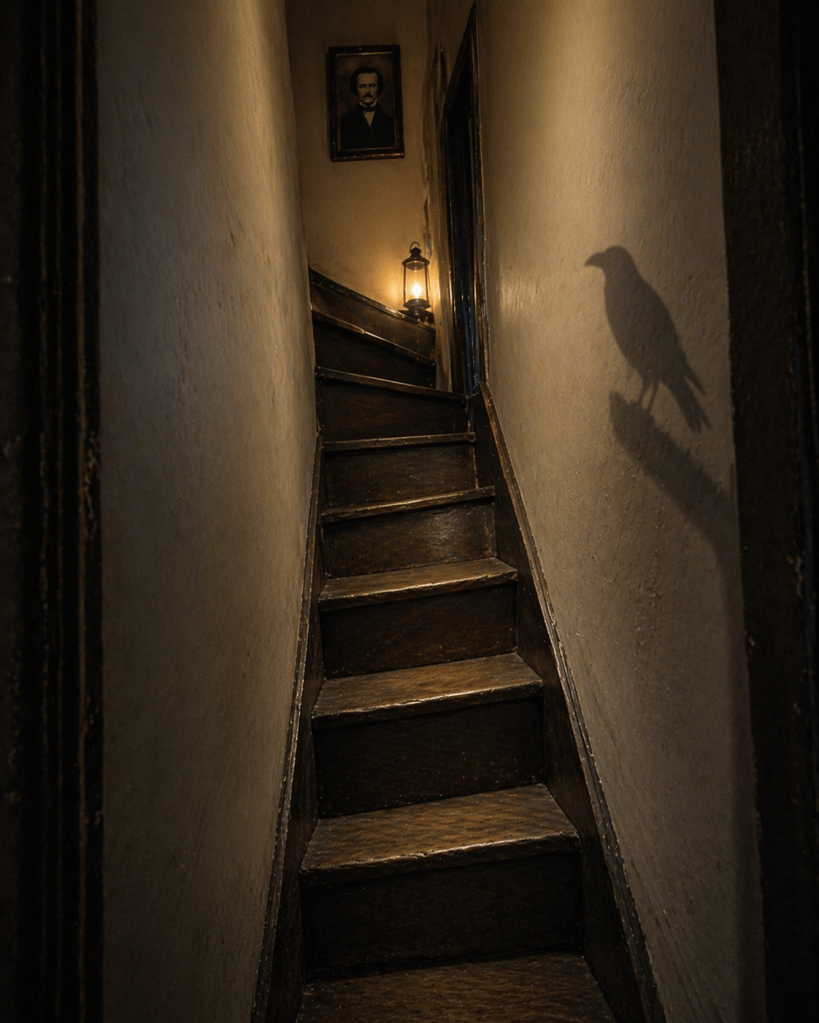
I’ve just returned from a trip to Baltimore, where I had the chance to visit the home and grave of Edgar Allan Poe. Both the house and grave impressed me. The house was so small, sad and desperate. Standing inside, it was impossible not to feel how confined life must have been there. The two stairways were twisted, steep and narrow. The space made the reality of his circumstances more immediate–not just an idea from his biography, but physical and present. It brought a clearer sense of the poverty and difficulty his family lived with.
Poe lived with his paralyzed grandmother, his aunt, her caretaker, his brother Henry and Virginia Clemm. They survived on the grandmother’s widow’s pension. The sign said that Poe was the first American writer to make a living from his writing. Not a very good living. He lived in the house for two years then moved to Richmond, Virgina. When his grandmother died, the Clemm family could no longer afford to live there. Poe came back and married Virginia and took them with him to Richmond.
It was a sobering experience. We, some of us anyway, take a lot for granted.
His grave, the marker is not the original. The original marker stands at the back of the cemetery near his grandfather, David Poe’s stone. The new marker is elaborate and large and looks a little out of place in the old cemetery. His gravesite was so popular they built a new entrance to the grounds. I was as impressed with the old cemetery as I was with seeing his graves. It reminded me of an America long gone. James McHenry of Fort McHenry is buried there. It felt like a place of our founding fathers.
We often encounter writers through their wok, separated from the conditions in which that work was created. But seeing his house made it harder to keep those things apart. The writing and the life were not separate. One existed within the other.
That is something I think about in my own work. In writing historical fiction, I try to understand not only what happened, but what it may have felt like to live within those circumstances–the limits, the pressures, and the realities that shaped people’s lives. Seeing Poe’s house made that more real.
Current projects:
- My book: continuing work on Chapter 10.
- Edward Bryant: continuing to review stories for the next publication.
History becomes more immediate when we stand in the places where it was lived.
Thanks for reading and walking alongside me.

